
Views: 0 Author: Site Editor Publish Time: 2026-04-28 Origin: Site
In automotive exterior manufacturing, bumper components may look similar at a glance, but the mould design behind them often reflects very different engineering priorities. The front bumper usually faces more styling complexity, tighter integration with lighting, grille systems, sensors, and airflow features, while the rear bumper tends to be shaped more by structural support, trunk geometry, reflector positioning, parking systems, and lower trim assembly. Because of this, Car bumper moulds for front and rear applications cannot always follow the same design logic. Toolmakers, automotive suppliers, and OEM buyers need to understand these differences clearly, since mould structure has a direct effect on surface quality, demoulding stability, cycle time, cooling efficiency, maintenance difficulty, and long-term production consistency. Looking closely at how front and rear bumper mould design differs helps manufacturers make more practical decisions at the tooling stage and reduces avoidable issues later in mass production.
Although both parts belong to the same vehicle system, they perform somewhat different functions and face different assembly demands. A front bumper is often more visually dominant. It may include larger visible styling zones, more airflow openings, fog lamp areas, sensor windows, grille transitions, or aerodynamic features. These details influence how the mould is split, where sliders are placed, and how the plastic flows during injection.
A rear bumper, by contrast, often needs to coordinate with trunk opening lines, taillamp contours, parking sensor integration, lower diffuser sections, and mounting features near the rear body structure. That makes the tooling approach different even when the material and machine tonnage are similar.
From a mould-making perspective, the geometry, appearance requirements, and assembly interface of the part strongly affect how the mould should be built.
Before discussing technical tooling details, it helps to understand that the part function shapes the mould strategy.
· stronger visual appearance requirements
· complex air intake or grille regions
· integration with front-end styling language
· sensor, camera, or radar accommodation
· lightweight design with controlled stiffness
· integration with rear body shape
· parking sensor or reflector positioning
· support for lower trim or diffuser components
· structural coordination with trunk and tail area
· impact-related reinforcement zones in selected areas
Because of these differences, Car bumper moulds must often be customized in their gating system, parting layout, ejection method, and cooling scheme rather than treated as interchangeable tooling concepts.
One of the most noticeable differences between front and rear bumper mould design lies in part geometry. Front bumpers often contain deeper styling transitions, more aggressive curves, and more cutout areas. This creates a bigger challenge for mould engineers.
· more side actions for undercuts
· more careful parting line concealment
· improved venting around deep features
· better control of sink marks near styled ribs
· more balanced filling for irregular shape zones
Rear bumpers can also be complex, but their geometry is often somewhat more continuous in key visible zones. Even when the rear part includes sensor holes or diffuser-related features, the overall flow path may be more manageable depending on vehicle design.
That said, this is not a strict rule. Some modern rear bumper designs are extremely sculpted. Still, in many projects, the front bumper mold presents more visible styling pressure and therefore demands tighter tooling control.
The parting line is one of the most sensitive elements in automotive bumper mold design, especially because bumpers are large exterior parts where appearance matters greatly.
Parting lines usually need to be hidden carefully around visible surfaces. Designers try to avoid placing them in highly noticeable styling zones or across decorative contours where mismatch could be obvious after painting. Because the front bumper is often one of the first visual elements people see on a vehicle, mould makers usually spend more time refining this layout.
Rear bumpers still require good appearance, but the parting line strategy may have slightly more flexibility depending on the vehicle’s rear styling and assembly coverage. Some line transitions can be coordinated with reflectors, lower garnish sections, or less visually sensitive edge areas.
A poorly planned parting line can lead to:
· visible mismatch
· burr or flash issues
· difficult mould fitting
· unstable demoulding
· additional trimming and finishing work
This is why front bumper mould and rear bumper mould projects often differ early in the design review stage, even if their dimensions appear comparable.
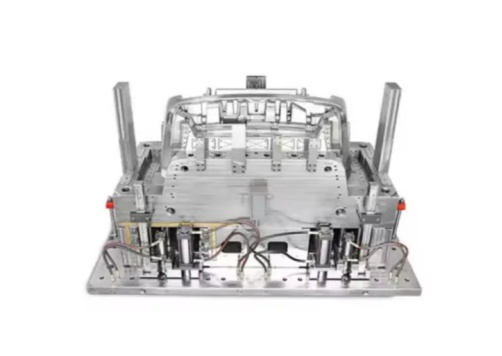
Large plastic parts are highly sensitive to filling behavior. Because bumpers are long and wide, gate location has a major influence on weld lines, warpage, filling pressure, and final appearance.
A front bumper typically has more functional openings and stronger style transitions. The melt flow must travel around cutouts, ribs, and design features without producing unacceptable weld marks in visible areas. This may require:
· carefully selected multi-point gating
· balanced runner design
· strong flow simulation input
· additional focus on appearance-sensitive weld line control
A rear bumper also needs balanced filling, but the preferred gate positions may differ because of part thickness distribution, mounting structure, and local geometry. In some cases, the rear part provides slightly more freedom for gate arrangement, though this depends heavily on the product design.
Design Aspect | Front Bumper Mould | Rear Bumper Mould |
Styling complexity | Often higher | Moderate to high |
Airflow openings | More common | Less common |
Sensor integration | Frequent in advanced models | Frequent for parking systems |
Parting line sensitivity | Very high | High |
Gate placement difficulty | Often more challenging | Usually more flexible |
Slider demand | Often higher | Depends on diffuser and trim zones |
Appearance control focus | Strong emphasis on visible front face | Strong emphasis on rear contour consistency |
This table does not mean every front bumper is harder than every rear bumper, but it reflects the common design tendencies seen in many production programs.
Undercuts are one of the most important factors in plastic injection bumper mould design. They affect mould complexity, cost, maintenance, and production stability.
· lamp washer areas
· fog lamp recesses
· side air curtain channels
· grille interface details
· sensor mounting zones
· diffuser connection features
· reflector seats
· parking sensor geometries
· exhaust outlet styling areas
· mounting tabs near wheel arch regions
The difference is not just how many undercuts exist, but where they are located and how they influence tooling movement. Front bumper moulds may require more precise coordination between sliders and visible Class A surfaces. Rear bumper moulds may focus more on structural transition zones and lower assembly features.
The difference between front and rear bumper mould design is not simply a matter of shape variation. It reflects deeper differences in function, styling pressure, assembly logic, undercut distribution, flow behavior, surface expectations, and maintenance priorities. Front bumper tooling often demands more careful control over visible complexity and airflow-related geometry, while rear bumper tooling may place greater emphasis on structural fit, sensor integration, lower trim compatibility, and rear-end assembly stability. For manufacturers and sourcing teams, understanding these distinctions helps create better communication during product development and reduces the risk of choosing an oversimplified tooling approach for a highly specialized part.
From our perspective as a mould manufacturer, the most effective tooling decisions always begin with a realistic review of the product, not with assumptions that front and rear bumper projects can follow the same template. We believe good results come from balancing appearance, mould structure, processing stability, and long-term maintenance from the beginning of the project. For companies that want to evaluate Car bumper moulds in more detail or discuss a practical solution for front bumper mold and rear bumper mold development, it is worth learning more from Zhejiang Taizhou Huangyan Shengfa Mould Co., Ltd. We would suggest speaking with an experienced team that understands both tooling design and production reality, so the final mould is not only workable in theory but dependable in real manufacturing as well.
Front bumper moulds often involve more visible styling features, grille openings, lamp-related details, and airflow structures, which can increase gating, slider, and surface control difficulty.
They may use similar automotive plastic materials, but the mould design can still differ greatly because part geometry, wall distribution, and assembly features are not the same.
A well-planned parting line helps reduce visible mismatch, flash, and finishing issues, while a poor layout can harm appearance and make mould fitting more difficult.
Buyers should review automotive mould experience, large-part machining capability, understanding of visible surface quality, tooling stability, and after-delivery technical support.


