
Views: 0 Author: Site Editor Publish Time: 2026-04-21 Origin: Site
When manufacturers talk about bumper quality, they often focus on part design, injection parameters, or cycle time. Yet one of the most important decisions is made much earlier, at the mould material selection stage. For Car bumper moulds, the chosen material influences far more than hardness alone. It affects wear resistance, surface finish stability, dimensional precision, repairability, cooling performance, maintenance frequency, and the total production life of the tool. Because bumper parts are large, visible, and often produced in high volume, the mould must perform reliably under repeated thermal and mechanical stress. A poor material choice may lead to premature wear, deformation, polishing issues, or rising production costs over time. A good choice, on the other hand, helps the mould run more consistently, deliver better part quality, and remain economically practical across long production cycles.
A car bumper is not a small or simple injection-molded part. It usually has a large surface area, visible exterior quality requirements, and demanding dimensional expectations. In many cases, bumper moulds must also support complex structures such as side actions, inserts, hot runner layouts, and carefully controlled cooling channels.
That means the mould material cannot be selected only by price or by habit. It has to match the production target. If the expected output is high, the mould material should offer long-term wear resistance. If the part surface requires a refined appearance, the steel should support good polishability. If the project demands faster maintenance turnaround, machinability and repair performance may become equally important.
In short, material selection determines whether the mould will remain stable in real production rather than just perform acceptably during trial runs.
Before comparing specific materials, it helps to define the key performance criteria. Different projects may prioritize them differently, but for most automotive bumper mould applications, the following factors are central.
Bumper moulds often run in long production cycles. Repeated injection pressure, sliding components, and continuous opening and closing place stress on the mould surface and structural parts. Better wear resistance generally means longer service life and more stable dimensions.
High hardness alone is not enough. A mould material also needs sufficient toughness to resist cracking, edge damage, and stress-related failure in demanding production environments.
Because bumper parts are visible exterior components, surface quality matters. A mould steel with good polishability supports smoother cavity finishing and more stable part appearance.
Efficient machining can reduce lead time and manufacturing cost. This matters especially for large moulds, where roughing and finishing require significant processing time.
Some mould materials provide strong performance only when heat treatment is well controlled. A steel that is theoretically excellent may still create problems if heat treatment consistency is poor.
These criteria help buyers and engineers move beyond simple steel grade names and think in terms of actual mould performance.
Pre-hardened steels are widely used in plastic injection mould for bumpers because they offer a practical balance between performance and manufacturing efficiency. These steels are supplied in a pre-hardened condition, reducing the need for complex post-machining heat treatment.
A major advantage is convenience. Since pre-hardened steels can often be machined and assembled directly, they help reduce lead time. They also tend to offer good machinability, reasonable toughness, and acceptable performance for many medium- to large-size bumper mould applications.
· Stable processing efficiency
· Reduced distortion risk from later heat treatment
· Good balance of strength and machinability
· Suitable for many general production projects
For extremely high-volume production or highly abrasive conditions, pre-hardened steel may not always provide the longest life compared with higher-hardness tool steels. The decision depends on output goals, resin characteristics, and expected maintenance cycles.
Even so, for many bumper mould projects, pre-hardened steel remains one of the most cost-effective starting points.
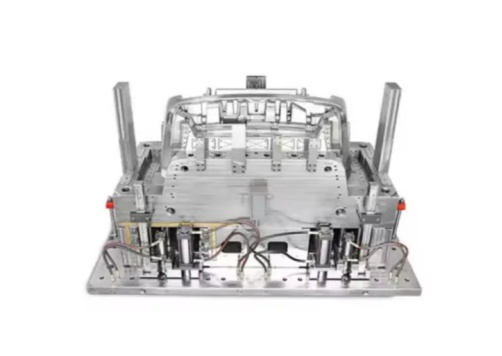
When production volume is high and long-term durability is critical, hardened tool steel often becomes the preferred option. These materials generally require heat treatment after machining, but they can provide stronger wear resistance and longer service life.
A hardened steel solution is especially useful when the mould must withstand repeated production over extended runs with tight dimensional stability requirements. In such cases, a stronger steel can reduce the risk of cavity wear, edge damage, and frequent corrective maintenance.
However, the benefits come with trade-offs. Machining is more demanding, processing cost may increase, and heat treatment control becomes more important. If the bumper project does not require that level of performance, a hardened steel may offer more capability than the application actually needs.
This is why steel selection should follow the project requirement rather than the assumption that harder is always better.
In real mould manufacturing, a few steel categories appear repeatedly because they have proven workable for bumper applications. Exact grade selection varies by region, supplier standards, and customer expectations, but the following comparison helps explain the logic behind common choices.
Material Type | Typical Strengths | Possible Limitations | Common Use in Bumper Moulds |
Pre-hardened mould steel | Good machinability, balanced toughness, shorter lead time | Moderate wear resistance compared with hardened grades | General bumper mould bases and cavity/core applications |
Hardened tool steel | High wear resistance, longer service life | Higher machining and heat treatment demands | High-volume production and critical wear areas |
Stainless mould steel | Better corrosion resistance, good surface stability | Higher material cost, application-specific need | Special environments or resins requiring corrosion resistance |
Alloy steel for inserts/sliders | Strong local durability for moving areas | Not always needed for the whole mould | Side actions, inserts, wear-prone components |
This table shows that there is rarely one universal “best” material. In many cases, a combination strategy works better than a single-steel solution.
Stainless steel is not always the first choice for bumper moulds, but it can be valuable in certain situations. If the production environment involves higher humidity, aggressive cooling conditions, or materials that increase corrosion risk, stainless steel may support longer-term mould stability.
Its appeal is not only corrosion resistance. Some stainless mould steels also maintain good surface quality, which can matter in exterior automotive parts where appearance is closely controlled. However, stainless options are usually selected for specific reasons rather than as a default material.
For standard bumper mould programs, many manufacturers still prefer more conventional mould steels unless corrosion resistance is a confirmed need. The point is not to choose stainless steel because it sounds premium, but to choose it when the application benefits from its actual properties.
Choosing the right material for bumper mould manufacturing is not about following one fixed rule or assuming one steel grade suits every project. It is about understanding how mould life, part quality, production volume, maintenance expectations, and processing capability interact in real manufacturing conditions. For Car bumper moulds, durability depends not only on hardness, but on the full balance of wear resistance, toughness, polishability, machinability, and design strategy. In many successful projects, the best result comes from selecting materials by function, reinforcing high-wear areas intelligently, and aligning steel choice with the actual production goal instead of relying on habit.
From our perspective, this is exactly where professional mould experience becomes valuable. At Zhejiang Taizhou Huangyan Shengfa Mould Co., Ltd., we believe mould material selection should serve long-term performance rather than short-term assumptions. As a company working in mould manufacturing, we understand that customers need durable tools, stable output, and practical technical judgment throughout the project. If you are evaluating car bumper mold steel, comparing material options, or planning a new automotive bumper mould program, you can learn more from Zhejiang Taizhou Huangyan Shengfa Mould Co., Ltd. and discuss a suitable direction with us in a straightforward and professional way.
Many Car bumper moulds use pre-hardened mould steel because it offers a practical combination of machinability, toughness, and reasonable durability for large plastic parts.
No. Car bumper mold steel should match the expected production volume, maintenance plan, and part quality requirements. A harder steel may last longer, but it can also increase processing difficulty and cost.
In an automotive bumper mould, different components experience different stress levels. Using stronger steels in inserts, sliders, or wear areas can improve durability without increasing the cost of the full mould unnecessarily.
For a plastic injection mould for bumpers, higher production volume usually requires better wear resistance and longer-term stability, while lower-volume projects may benefit more from easier machining and shorter lead time.


