
Views: 0 Author: Site Editor Publish Time: 2026-04-20 Origin: Site
In automotive manufacturing, bumper quality is judged immediately. Even a small surface defect, dimensional deviation, weld mark, sink mark, flash line, or warpage issue can create assembly trouble, painting problems, or visual rejection at the customer end. That is why the design of Car bumper moulds is not simply a tooling task, but a process that directly affects product appearance, production efficiency, and long-term project profitability. A bumper is a large, thin-wall, high-appearance plastic part with demanding structural and dimensional requirements, which means the mould must balance filling behavior, cooling uniformity, venting efficiency, ejection stability, and repeatable cycle performance all at once. If any one of these factors is poorly controlled, zero-defect production becomes difficult to achieve.
Bumpers are among the most visible exterior plastic parts on a vehicle. Unlike internal components, they cannot hide minor molding flaws. A defect that might be tolerated in another part often becomes unacceptable in a bumper program.
Zero-defect performance matters because it influences:
· visual quality and paintability
· downstream assembly fit
· cycle stability in mass production
· scrap and rework cost
· customer acceptance and brand reputation
For this reason, automotive bumper mould design must focus not only on producing the first approved sample, but on maintaining stable quality throughout long production runs.
Before the mould structure is finalized, the bumper part itself should be reviewed from a manufacturing perspective. Many later defects originate from part geometry that creates uneven filling, weak venting, or unstable cooling.
Large differences in wall thickness often lead to sink marks, differential shrinkage, and local warpage. A more balanced wall structure helps resin flow more evenly and reduces stress concentration.
Reinforcing features are necessary, but poor placement can create read-through marks or local deformation on visible surfaces. These details should be designed with both structure and appearance in mind.
Abrupt geometry changes interfere with flow and cooling. Smooth transitions are usually better for both molding stability and part strength.
Because bumpers must match the vehicle’s outer design language, mould designers often work within strict styling limits. Even so, early collaboration between product engineers and mould engineers can eliminate avoidable defect risks.
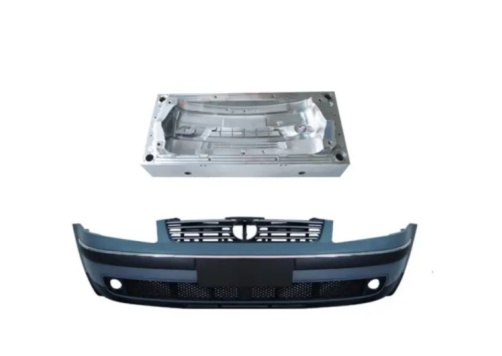
Material selection inside the mould itself also affects defect control. Since bumpers are produced in high volumes and require stable surface quality, mould steel should be selected based on wear resistance, polishability, toughness, and long-term dimensional stability.
A few practical considerations include:
Design Factor | Why It Matters | Impact on Defect Control |
Core and cavity steel quality | Affects durability and machining stability | Helps maintain dimensional accuracy over long runs |
Surface finish capability | Influences appearance and texture quality | Reduces visible surface defects |
Mould base rigidity | Prevents deformation under repeated clamping pressure | Lowers risk of flash and mismatch |
Insert design | Supports local replacement and maintenance | Improves control of wear-prone zones |
Heat treatment quality | Affects hardness and service life | Helps keep part consistency stable |
For a precision plastic auto mould, the steel decision is not only about lifespan. It also determines how well the mould holds tolerance under continuous production pressure.
Filling behavior is one of the most critical factors in bumper molding. Because the part is large and often geometrically complex, an unbalanced filling pattern can create weld lines, air traps, short shots, gloss inconsistency, or localized stress.
Many bumper applications require multiple gates to ensure consistent flow over the full part length. The challenge is to place them in positions that balance filling without creating visible gate-related quality issues.
The runner system should support stable material delivery with minimal pressure imbalance. Poor runner design may cause one region to fill too early while another remains under-packed.
Gate positions must consider both technical flow requirements and surface appearance demands. A technically convenient gate is not always acceptable if it creates marks in a critical visible area.
Weld lines cannot always be eliminated completely, but they can often be moved to less critical zones through better gate planning. This is especially important in bumper injection mould projects with demanding cosmetic standards.
Balanced gating is one of the clearest differences between a mould that “works” and a mould that runs efficiently with low rejection.
Cooling design has a direct effect on cycle time, shrinkage consistency, and part deformation. In large automotive parts like bumpers, poor cooling layout is one of the most common reasons for warpage and unstable dimensions.
The goal is not simply fast cooling, but even cooling. If one section of the bumper cools much faster than another, internal stress increases and the part is more likely to twist or distort after ejection.
Areas near thick sections, mounting features, or complex geometry often retain more heat. These zones need dedicated cooling attention.
Cooling channels must be close enough to control temperature effectively without weakening the mould structure or causing maintenance risk.
A shorter cycle is attractive, but if the part is ejected before it is dimensionally stable, defect rates rise. In Car bumper moulds, cooling design should balance productivity with repeatable part quality.
Air management is another major issue in bumper moulding. Because of the large projected area and long flow length, trapped gas can easily cause burn marks, incomplete filling, surface streaks, or weak weld zones.
Vents should be placed where air is naturally pushed during filling, especially near end-of-fill zones and complex transitions. Too little venting causes defects, but excessive venting can create flash risk.
A poorly controlled parting line can lead to mismatch, flash, and visible trimming issues. Since the bumper is a high-appearance exterior part, parting line quality must be tightly managed.
In some designs, inserts, sliders, or deep features create local gas traps. These areas require additional venting strategy beyond standard edge vents.
Once filling and cooling are complete, the part still has to leave the mould safely. A weak ejection design can damage the bumper even when everything else in the cycle is working correctly.
Ejector distribution
The ejection force must be spread across the part in a way that avoids local pressure marks or bending.
Support for thin-wall areas
Large thin-wall parts are sensitive during release. Ejection points should be arranged to protect weaker zones from distortion.
Controlled demolding sequence
In some bumper moulds, sliders, lifters, or special release actions must operate in a precise sequence. Poor coordination can result in drag marks or edge damage.
Surface protection
Because bumpers are visible parts, even small ejection marks can become unacceptable. The design should protect both structure and appearance.
A high-quality automotive bumper mould design treats ejection as a core engineering issue, not just a final mechanical step.
From our perspective, optimizing Car bumper moulds for zero defects is not about relying on one special trick. It comes from building a complete mould system in which part geometry, steel selection, gating, cooling, venting, ejection, simulation, and process control all support each other. Bumper programs are demanding because they combine cosmetic expectations with large-part molding complexity, which means even small design weaknesses can quickly turn into repeated production defects. A well-developed mould should not only produce acceptable samples, but also run stably, hold tolerance, reduce rework, and support efficient maintenance through the full production cycle. At Zhejiang Taizhou Huangyan Shengfa Mould Co., Ltd., we believe the best tooling results come from careful engineering, realistic production thinking, and close attention to long-term consistency rather than short-term approval alone. For companies looking to improve bumper tooling quality or discuss a more reliable approach to automotive mould development, it is worth learning more from Zhejiang Taizhou Huangyan Shengfa Mould Co., Ltd. and exploring the right solution for the actual project requirements.
The most common issues include warpage, sink marks, weld lines, flash, short shots, burn marks, and parting line mismatch. These usually result from a combination of filling, cooling, venting, and ejection problems.
Because bumpers are large and thin-wall parts, uneven cooling can quickly lead to shrinkage differences and deformation. A well-designed cooling system improves both cycle stability and dimensional accuracy.
No. Simulation is very useful for predicting risk and improving design choices, but real-world mould trials and production validation are still necessary to confirm stable performance.
Long-term consistency depends on strong initial design, proper steel choice, precise machining, controlled process setup, and regular maintenance. Maintenance-friendly mould structure is especially important for sustained zero-defect production.


